 Tofu Labs
How Find the Killer games work
A Find the Killer game is a murder mystery you solve on paper. There are no actors and no host. You get a story, a list of everyone who was at the scene, and a set of clues about the killer. Each clue lets you rule people out. Use every clue, and one name is left.
It's part logic puzzle, part detective story, and it's very relaxing once you get into the rhythm. Here's how it works.
The register
Every case comes with a register: the guest book of the fair, the passenger list of the train, the coat check of the ballroom. It lists every person who could have done it, one per row, with a few details: age, height, hair color, hometown, what they ate or drank. Our full cases have between 1,600 and 3,000 people in the register. The free mini case has 192.
The clues
Every clue describes the killer. For example: "The killer's age is an even number." Anyone in the register who doesn't fit can't be the killer, so you cross them out.
Clues come in a few kinds:
- One of: "The killer's cider was one of: Sweet, Dry." Keep only people with Sweet or Dry.
- None of: "The killer's hometown is none of: Hatchet Lane, Tansy Green." Cross out anyone from those two places.
- Ranges: "The killer is between 22 and 42 years old (both ages included)." 22 and 42 both stay in.
- Letters: "The killer's first name begins with a letter from G to S."
- If... then: "If the killer is from Copperleaf, they had red hair." This one only rules out people from Copperleaf who don't have red hair. Everyone else stays. These trip people up the most.
A worked example
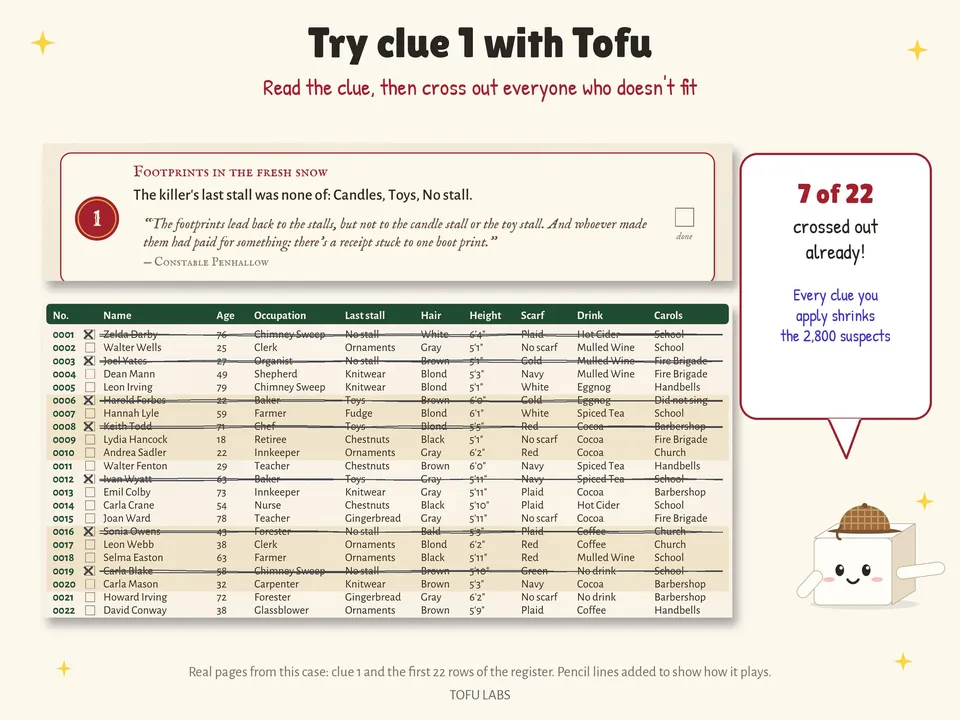
In our free case, Last Pressing at Copperleaf Mill, the first clue is "The killer's age is an even number." Go down the register and cross out everyone with an odd age. That removes 86 of the 192 visitors and leaves 106.
The second clue says the killer's cider was neither Spiced nor Hot. Now you only check the 106 people still standing, and cross out the Spiced and Hot drinkers. Down to 56. Each clue goes faster than the one before, because the list keeps getting shorter.
How to solve one without getting lost
- One clue at a time, through the whole list. Don't try to apply three clues to each row. It's slower and you'll miss people.
- Tick the clue off when it's done. Our case files have a little box next to every clue for this.
- Count what's left after each clue. If your count suddenly drops to zero, you've misread a clue, usually an "if... then" one.
- Use a pencil or a highlighter, not a pen. Mistakes happen around row 1,400.
- Play in pairs if you like. One person reads the clue out, the other crosses names out, then swap. It's a nice slow evening for two.

Tofu's tip: the clues can be used in any order, and the answer is the same. Start with the clues that knock out the most people, and the long register gets short fast.
How long does one take?
The free mini case takes about 10 to 15 minutes. A full case with 2,000 or more suspects is a project: most people spread it over a few evenings, the way you'd work through a big jigsaw. Our Christmas case is meant for five to eight hours of cozy sleuthing in total.
Is it fair?
Yes. Every case has exactly one answer, and every clue matters: if you skip one, more than one name is left. Each case is test-solved before it goes in the shop, and a separate solution file tells you who did it and how many people each clue ruled out, so you can check your work step by step.
Paper or tablet?
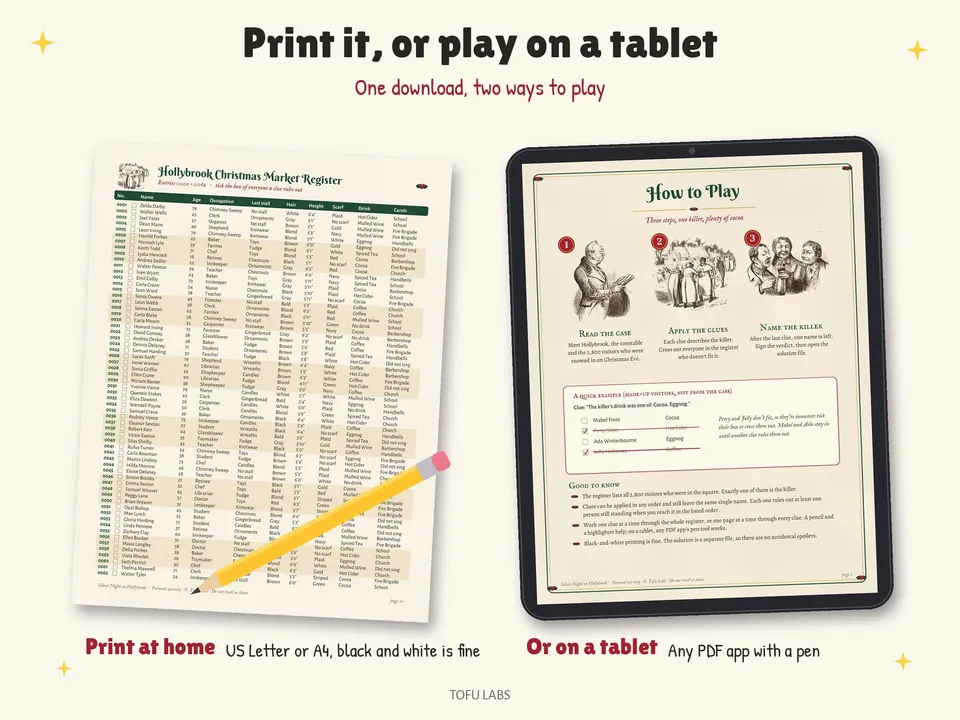
Both work. On paper you'll want the register printed, plus a pencil. On a tablet, open the case in an app that lets you draw on pages (GoodNotes, Notability, or the free markup tools on iPad and Android), and cross names out with your finger or a stylus.
Try one now
The quickest way to see if you'll like it is to play our free mini case. You can play right in your browser, and your crossed-out names are saved as you go. If you enjoy it, the full cases are the same puzzle at a much bigger size.