 Tofu Labs
How to host a murder mystery night at home
A murder mystery night is a dinner party where everyone plays a character and one of them is the killer. Over the evening the guests trade gossip, read out clues and try to work out who did it. Nobody has to be a good actor. The game does the heavy lifting, and the host mostly keeps time and hands out envelopes.
We write these games for a living, and this is the plan we'd follow for a first party at home.
Pick the kind of game first
There are three kinds, and they suit different groups.
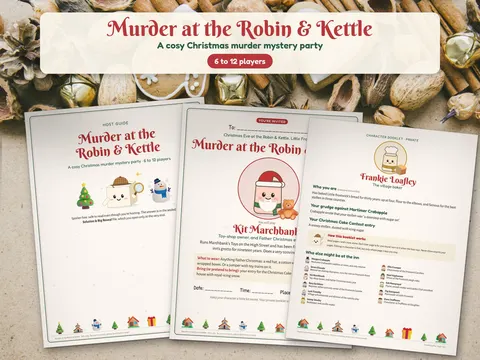
- A hosted party game (6 to 12 people). Each guest gets a character booklet with a secret and an alibi. The clues come out over three rounds, usually one per course. This is the classic dinner-party version. Our Murder at the Robin & Kettle is one of these.
- A puzzle mystery (1 or 2 people). There are no characters to play. You get a case file and solve it with a pencil, like a long logic puzzle with a story. Good for a quiet night or a couple. Our Find the Killer cases work this way.
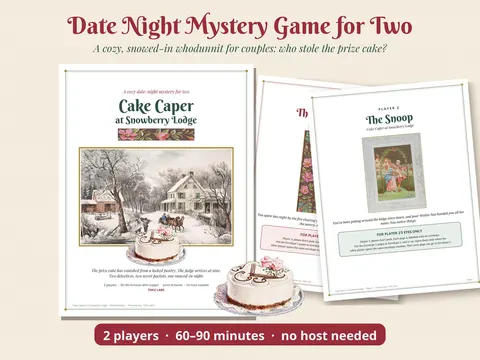
- A game for two. Each player holds half the clues and can't show their pages, so you have to talk. It's a good date night in.
If you have more than five people and they like chatting more than puzzles, choose a hosted party game.
How many guests?
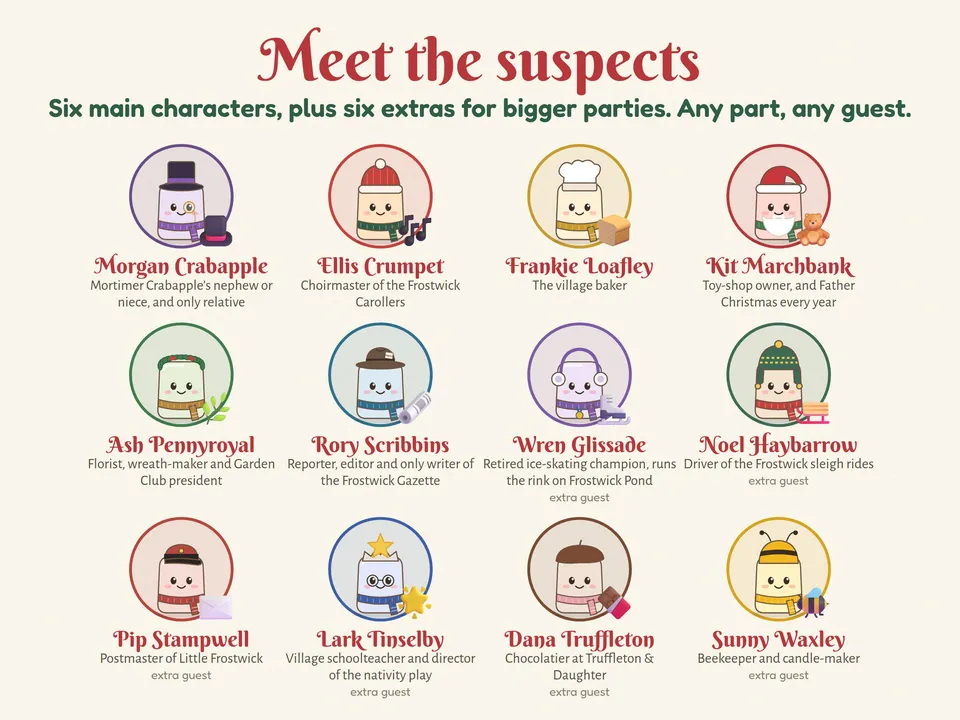
Six to eight is the easiest number. Everyone gets a real part, the table conversation stays in one piece, and the evening doesn't drag. With ten or twelve it's louder and more fun, but you'll want a game that has extra characters, so the late additions aren't left holding a part with nothing to do.
Give the main roles to the guests who are most likely to turn up. In most party games the killer is one of the main characters, and a missing killer is the one thing the evening can't recover from.
Two weeks before: invitations
Send each guest their character with the invitation: their name in the game, one line about who they are, and a costume idea. People enjoy the costume much more when they know who they're dressing as. Keep the costume ask small ("something red", "a hat"), and most people will join in.
Don't send the secrets yet. Hand out the full character booklets when guests arrive, so nobody reads ahead and nobody forgets theirs at home.

Tofu's tip: put the start time half an hour before you actually want to begin. Arrival, coats and the first drink always take longer than you think.
Food that fits the game
Three courses fit three rounds well: a starter during round one, the main course during round two, dessert for the accusations. If cooking a full dinner sounds like too much, a long table of nibbles works just as well, and the host gets to play instead of running to the oven.
Whatever you serve, people will be reading booklets and passing clue cards around, so pick things they can eat with a fork or with their fingers. A pot of something you made the day before is perfect.
On the night
| Time | What happens |
|---|---|
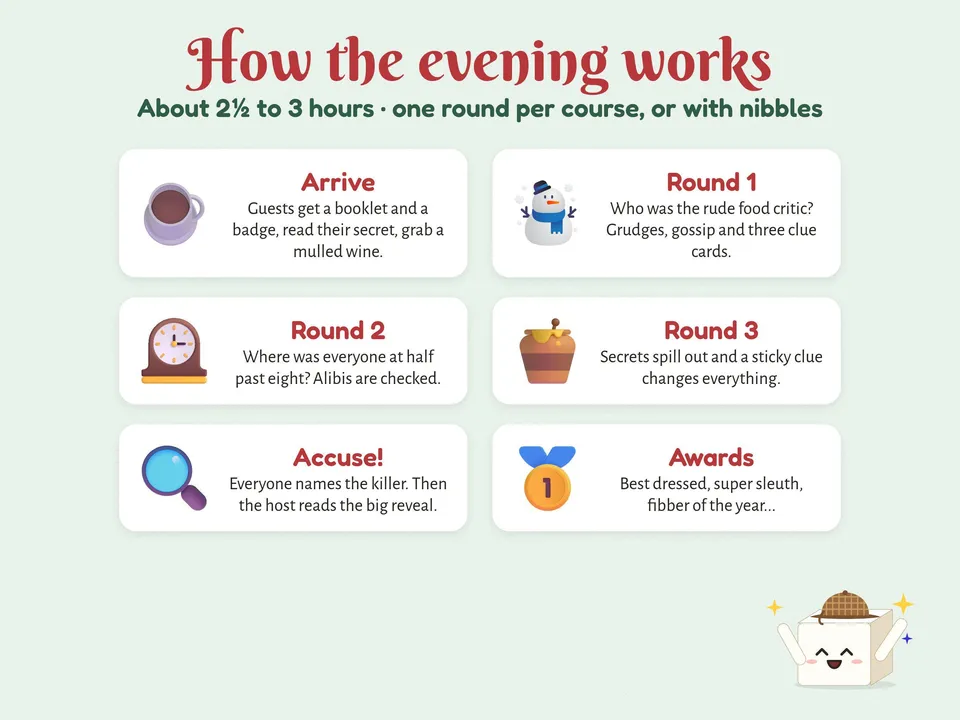
| 0:00 | Guests arrive, get a name badge and their booklet, and read their secret. |
| 0:20 | The host reads the opening scene out loud: who died, where, and why nobody can leave. |
| 0:30 | Round one. Everyone introduces their character, then the first clue cards are read. |
| 1:10 | Round two, over the main course. Alibis come out and someone's story stops adding up. |
| 1:50 | Round three. Secrets spill and the last clues are read. |
| 2:20 | Everyone writes down who did it and why. The host opens the sealed solution and reads the reveal. |
| 2:40 | Awards: best costume, best liar, best detective. |
That's about two and a half to three hours, which is what most hosted games are written for. If your group is chatty, let the rounds run long and skip a break rather than rushing the reveal.
Keeping it fun
- Tell guests they don't have to act. Reading the lines out in their own voice is fine. The shy ones usually loosen up by round two.
- Lying is allowed, except about clue cards. Characters can fib about their secrets, but the printed clues are always true. Say this at the start; it stops a lot of arguments.
- The host should play too, if the game allows it. Look for a host guide that doesn't give the answer away. Then you can enjoy your own party.
- Keep the drinks moderate until the accusations. The clues get a lot harder to follow after the third glass of mulled wine.
- Hand out awards. A paper "Best Dressed" card costs nothing, and people take them home and keep them.
What you'll need
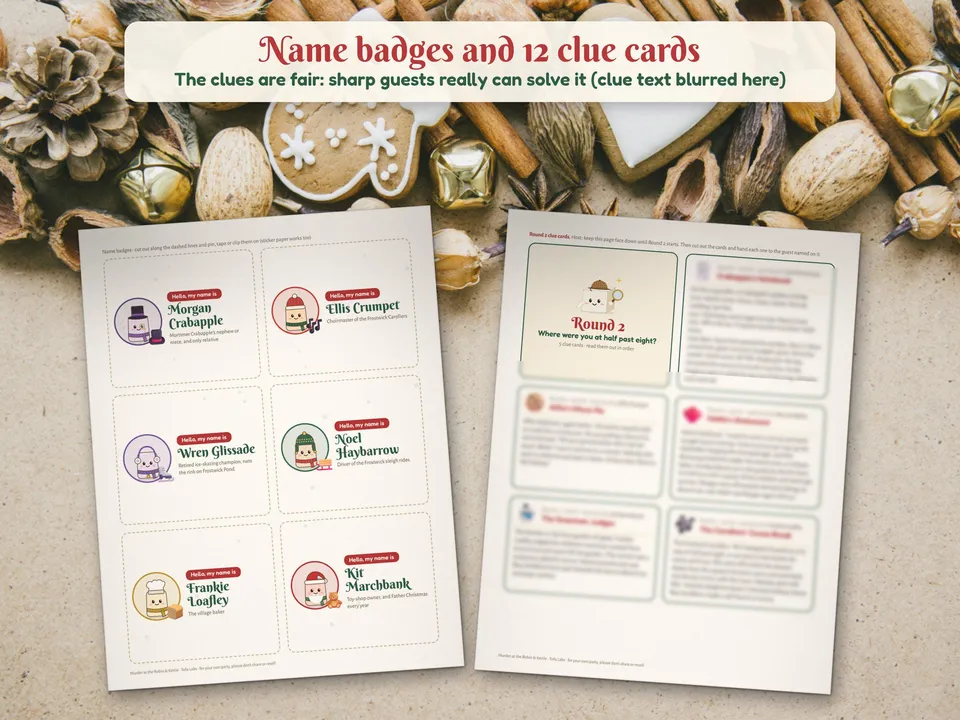
- The game itself, printed (black and white is fine for most games).
- Scissors for clue cards and badges, and envelopes if you want to seal each round.
- Pens and a little notepad for each guest.
- One small prop on the table: a candle, a "do not touch the evidence" sign, a teacup. It's surprising how much one prop sets the mood.
Want your friends to be the suspects?
Ready-made games use made-up characters. If you'd like every suspect to have a guest's real name, we also write custom murder mystery parties for groups of 6 to 20, with your guests cast in the parts.

Never played a murder mystery at all? Try our free mini mystery first. It takes about fifteen minutes and shows you how clues narrow down a list of suspects.